In the fast-paced, interconnected world of modern business, managing your cash flow is the difference between thriving and merely surviving. At the very heart of healthy cash flow is a fundamental, time-tested document that every freelancer, small business owner, and massive corporation relies on: the invoice.
While the concept might seem straightforward—you provide a good or service, and you ask to be paid—the intricacies of proper invoicing are vast. From ensuring legal compliance to navigating international transactions where a client might request an invoice deutsch (a German invoice), understanding how to bill correctly is a critical business skill.
In this comprehensive guide, we will explore exactly what an invoice is, break down its primary use cases across different industries, and delve into how modern platforms like Flipinvoice can help you generate professional bills in multiple languages. We will also touch on how to organize your financial life so you never have to panic when you need to get my invoices together for tax season.
Part 1: What is an Invoice?
At its most basic level, an invoice is a legally binding, time-stamped commercial document issued by a seller to a buyer. It itemizes and records a transaction between the two parties. If goods or services were purchased on credit, the invoice usually specifies the terms of the deal and lists available payment methods.
It is important to distinguish an invoice from other common financial documents:
- Invoice vs. Receipt: An invoice is a request for payment issued before or after the service is rendered but before payment is made. A receipt is proof of payment issued after the transaction is complete.
- Invoice vs. Purchase Order (PO): A purchase order is generated by the buyer to request goods or services from a seller. The seller generates an invoice to request payment for those goods or services.
- Invoice vs. Bill: While often used interchangeably, an invoice is typically what a business sends to a client (B2B), whereas a bill is what a consumer receives from a business (like a restaurant or utility bill).
The Anatomy of a Perfect Invoice
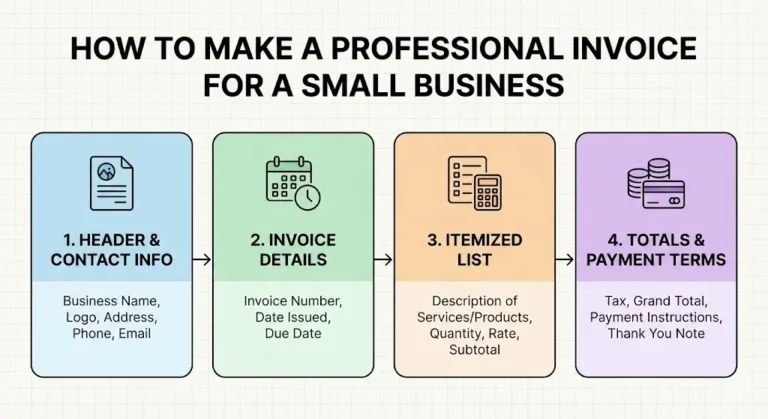
For an invoice to be considered legally valid—and to ensure you get paid as quickly as possible—it must contain several essential elements. Missing even one of these can lead to delayed payments and administrative headaches.
- The Word “Invoice”: The document must clearly state what it is at the very top.
- Unique Invoice Number: Every invoice must have a unique sequential number (e.g., INV-001, INV-002) for tracking, accounting, and tax purposes.
- Dates: The invoice must include the date it was issued and the date the goods or services were provided.
- Vendor Contact Information: Your business name, address, phone number, email, and tax identification number.
- Client Contact Information: Buyer’s name, billing address, and required contact details.
- Itemised Description of Services/Goods: A clear, line-by-line breakdown of exactly what the buyer is paying for, including the quantity, rate (hourly or flat), and the total for each line item.
- Subtotal, Taxes, and Discounts: The sum of all line items, any applicable discounts, and explicitly stated tax rates (such as VAT or Sales Tax).
- The Total Amount Due: The final, unmissable number that the client needs to pay.
- Payment Terms and Due Date: Clear instructions on when the payment is due (e.g., “Net 30” meaning due in 30 days) and how the client can pay (bank transfer, credit card, PayPal, etc.).
Part 2: Common Use Cases of an Invoice
Invoices are not a one-size-fits-all document. Different industries and business models utilize invoices in entirely different ways to facilitate their specific financial ecosystems. Here are the primary use cases:
1. Business-to-Business (B2B) Transactions
In the B2B world, goods and services are rarely paid for upfront. Instead, a company might order raw materials, software subscriptions, or consulting services on credit. The supplier will ship the goods or perform the service and then issue an invoice. This use case relies heavily on “Net” payment terms, allowing the receiving business time to process the expense through their own accounts payable departments before releasing the funds.
2. Freelance and Contract Work
The gig economy runs on invoicing. Graphic designers, freelance writers, software developers, and independent consultants do not receive standard paychecks. Instead, they track their hours or complete a project milestone and submit an invoice to their client. For freelancers, the invoice acts as their primary tool for income generation. It sets professional boundaries, clarifies the scope of work completed, and provides a formal avenue to chase down late-paying clients.
3. E-commerce and Retail Wholesale
While a customer buying a single pair of shoes online gets a receipt, a boutique buying 500 pairs of shoes from a manufacturer deals in invoices. Wholesale e-commerce relies heavily on pro forma invoices (an estimated invoice sent before goods are shipped) and commercial invoices (used for customs declarations).
4. International Trade and Customs
When goods cross international borders, the invoice becomes a critical legal document for government authorities. A commercial invoice is required for customs clearance. It determines the true value of the imported goods for the assessment of duties and taxes. In these use cases, the invoice must be incredibly detailed, often requiring specific harmonized system (HS) codes, the country of origin, and the specific currency of the transaction.
5. Recurring Subscriptions and Retainers
Many modern businesses, such as marketing agencies or software-as-a-service (SaaS) companies, operate on retainer or subscription models. In these cases, automated recurring invoices are generated monthly, quarterly, or annually. This ensures steady cash flow and saves the business from manually drafting a new document every single billing cycle.
Part 3: The Challenge of Global Billing and Language Barriers
As the digital economy erases geographical boundaries, it is more common than ever for a freelancer in the United States to have clients in Europe, or for a manufacturer in the UK to supply distributors in South America. However, global business brings a unique set of challenges, specifically regarding communication, currency, and local compliance.
When you send an invoice to an international client, clarity is paramount. If your client is located in Berlin, for example, their accounting department might require the document to be in their native language to remain compliant with local tax authorities. A client might explicitly request an invoice auf deutsch (invoice in German).
If you do not speak German, generating an invoice deutsch that uses the correct legal terminology (such as translating “Invoice” to “Rechnung,” or “Tax ID” to “Steuernummer”) can be incredibly daunting. Using standard translation apps like Google Translate is risky; a poor translation on a financial document looks unprofessional and can lead to misunderstandings, delayed payments, or issues with foreign tax audits.
Furthermore, international invoicing requires handling different currencies and varying tax regulations (like European VAT). Manually calculating these and adjusting your standard templates is a massive drain on your time and resources.
Part 4: How Flipinvoice Helps You Make Multilingual Invoices
This is where specialized invoicing software becomes a game-changer. While you might be familiar with various tools on the market, or perhaps you’ve used an invoice by invoiced template in the past, transitioning to a dynamic platform like Flipinvoice is crucial for scaling a global business.
Flipinvoice is designed to eliminate the friction of cross-border billing. It is an intuitive, robust platform that allows you to create, send, and manage professional invoices with built-in localization features. Here is how Flipinvoice helps you generate invoices in different languages seamlessly:
Automated Language Translation
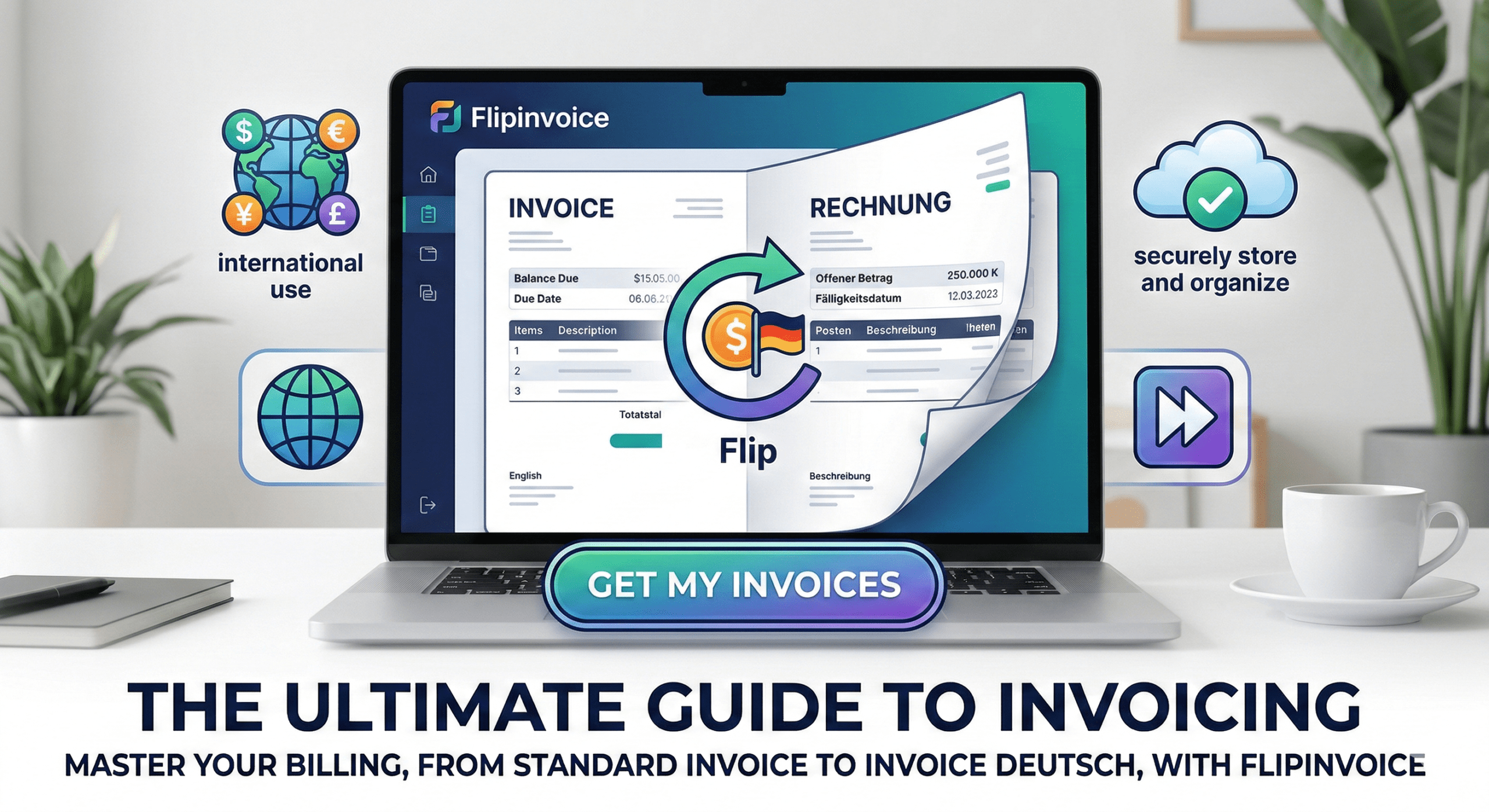
Flipinvoice takes the guesswork out of international billing. You can draft your invoice in your native language—say, English—inputting all the standard details like line items, descriptions, and payment terms. With the click of a button, Flipinvoice allows you to set the output language based on your client’s location.
If you need that invoice auf deutsch, the platform automatically translates the structural elements of the document into perfect, legally recognized German business terminology. The layout remains pristine and professional, ensuring your client’s accounting department can process it without delay.
Multi-Currency Support
Language is only half the battle. Flipinvoice allows you to issue bills in the currency of your client’s choosing. It can pull real-time exchange rates, ensuring that your pricing remains accurate and fair. You can easily switch a total from US Dollars to Euros, British Pounds, or Japanese Yen. This level of accommodation makes it incredibly easy for your international clients to pay you, which dramatically reduces your wait time for funds.
Customized Tax Settings
Tax regulations vary wildly from country to country. Flipinvoice allows you to customize tax rates per line item or per invoice. If you are dealing with a European client and need to apply VAT, or a Canadian client requiring GST, Flipinvoice allows you to apply the correct percentages and terminology effortlessly, ensuring your multilingual invoice is also legally compliant.
Client Portals and Automated Reminders
Communication doesn’t end when you hit “send.” Flipinvoice provides dedicated client portals where your customers can view their invoices in their preferred language, download them as PDFs, and pay directly via integrated payment gateways (like Stripe or PayPal). Furthermore, you can set up automated payment reminders. If an invoice goes past its due date, Flipinvoice will send a polite, localized reminder to the client on your behalf.
Part 5: Organizing Your Financial Ecosystem
Creating invoices is only the first step; managing them over time is equally important. When tax season rolls around, or when you are evaluating your quarterly profits, disorganized records can lead to disaster. You never want to find yourself frantically searching through email attachments, thinking, “Where do I get my invoices from last year?”
Using a centralized platform like Flipinvoice acts as your financial filing cabinet. Every invoice you create—whether it’s a domestic bill in English or an invoice deutsch for your European partners—is securely stored in the cloud. You can filter your dashboard by paid, unpaid, and overdue statuses. You can instantly export reports to hand over to your accountant, ensuring that every cent you’ve earned is properly documented and tracked.
By moving away from static spreadsheets and manual word-processor templates, you protect your business from human error. You build a scalable system that can handle one client or one thousand clients, speaking any language, located anywhere in the world.
Summary
Invoicing is the lifeblood of business operations. Whether you are navigating complex B2B supply chains, running an e-commerce empire, or working as a solo freelancer, understanding the anatomy and use cases of an invoice is non-negotiable.
As your business grows beyond your own borders, the ability to communicate financially in your client’s language becomes a massive competitive advantage. Tools like Flipinvoice remove the anxiety from this process, allowing you to generate perfectly translated, legally sound, and beautifully formatted invoices in seconds. By automating the heavy lifting of language and currency conversions, you can spend less time doing administrative paperwork and more time focusing on what you do best: growing your business.